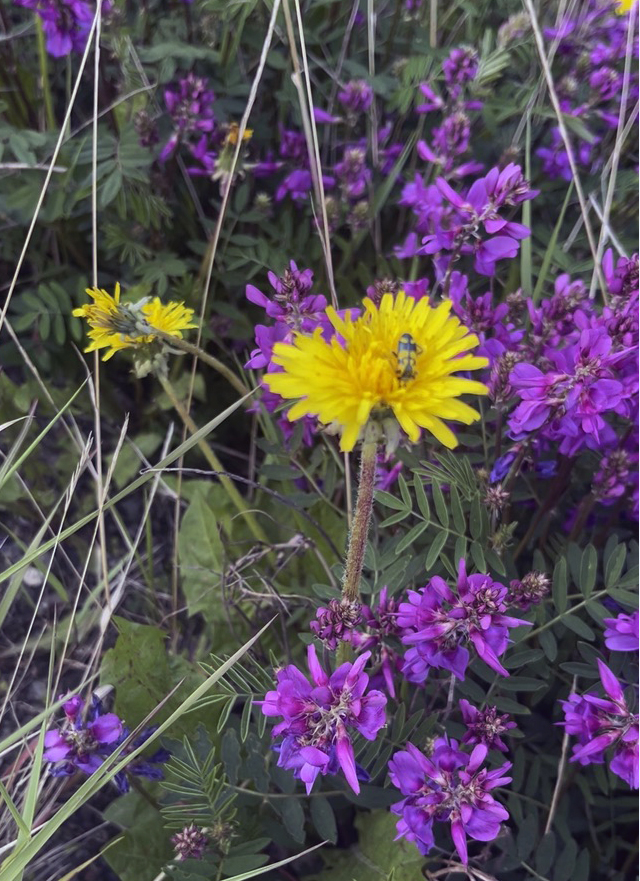
In my latest project, I explore how the Common Dandelion (Taraxacum officinale) – an introduced species and non-human settler from EurAsia – is a proxy and marker of human settler dispersal in the land now known as Canada.
Even a very small child will recognize a Dandelion and joyfully blow its puffball into the air. The popular nature platform iNaturalist shows 8,700 participants list over 21,000 observations of the plant across Canada. Yet does this plant — both maligned and cultivated — actually belong here? And may this settler plant present itself as a symbol of human settlers’ complex and layered relationship to the land itself?
I’m working with 6 and 4 feet screen prints of a tiny European woodcut dated 1597. Other materials I’m using include municipal maps, Google maps, herbarium samples (i.e. dried Dandelions preserved by scientists), iNaturalist data, field notes and photos.
My project intends to build a national, visual language of this settler plant. So far I’ve worked in the far North, on the Prairies and in BC and on Canada’s most southern inhabited land — Pelee Island, ON. Next, I plan to work in locations on the East coast.
I plan to provide updates on this project here and on Instagram @nandyheule.
The Dandelion’s pallid Tube/Astonishes the Grass – And Winter instantly becomes/An Infinite Alas – The Tube uplifts a signal Bud/And then a shouting Flower – The proclamation of the Suns/That sepulture is o’er. – Emily Dickinson, American poet, 1881