When Bill Allen arrived in Alberta from Ontario in the early 1900s he had a job to do. His employer, the Canadian Pacific Railway, assigned him the task to open a train station in Nanton, Alta., about 100 km south from Calgary. He is said to have done so in early 1903.
Next, Bill Allan was ready to become a homesteader. He filed three “¼ sections” of prairie land for himself, his father and his brother: SE-36-16-28-W4; NW-30-16-27-W4; NE-36-16-28-W4. Based on results from the Dominion Land Survey, these ¼ sections measured about 160 acres. The DLS is the world’s largest survey grid laid down in a single integrated system. It covers large sections of Alberta, Saskatchewan and Manitoba as well as parts of British Columbia.
In a 1974 interview for a family memoir, Bill Allen, by now 95 years old, recollects how he and his neighbours turned Shortgrass Prairie habitat into small farms:
“When I went on the homestead, the grass was about two feet high. We had to cut some of the grass down to clear a place to build our home. When we had our homestead […] first we had walking plows. We’d burn the grass off, put a fire guard around it, and then plow it with a walking plow. When we got far enough [ahead] to get four horses, we’d get a raking plow […]. And we put up hay for Pat Burns in the early days. I cut the hay with a team of ponies, then raked it up. My father and my brother and the neighbours, they stacked it. That was way back in around 1904. I raised a bunch of nice horses there and had a few cows. I built my own barn after the pattern of the ‘bank barn’ back in Ontario. My father laid it out for me and I done [sic] the work.”
Years after Bill Allen reminisced about burning the prairies, his grandson Jim Coutts, a Toronto-based lawyer and philanthropist, set out to restore the original homestead and reclaim the grasslands. No easy task, Coutts soon found out. He bought back the family’s original “¼ section” in 1988, and the efforts to restore its land has been an ongoing project since then.
Canadian prairies include native species with such fun common names such as needle-and-thread grass (Hesperostipa comate) and tufted hair grass (Deschampsia cespitose). Northern sweet grass (Anthoxanthum hirtum), Junegrass (Koeleria macrantha), little bluestem (Schizachyrium scoparium), the gorgeous ricegrass (Eriocoma hymenoides) and Western wheatgrass (Pascopyrum smithii) all thrive. These plants survive drought and unrelenting blazing sun in summer; they live through months of extreme cold and deeply frozen soil. A perennial bunchgrass species such as rough fescue (Festuca campestris) can reach up over 3 feet tall and reach 100-year time spans. The gorgeous big bluestem grass (Andropogon gerardii) can tower up to 8 feet in height.
Unfortunately, those aren’t the grasses Coutts planted on his farm. Like many others, Coutts relied on seed lists when he started to replant parts of his ¼ section. Such lists were often referred to as “Hydro Seed,’” says Kara Matthews. She is the horticulturalist working at what is now the Coutts Centre for Western Canadian Heritage. Prior to his passing in 2013, Coutts made a generous gift to the University of Lethbridge which now manages the Coutts Centre as an event venue with extensive public gardens, a house for artist residencies, kids camps, and other events.
“In the 90ties, (reclamation) seeds from Europe were used to grow cattle feed,” says Matthews. “Those seeds are more robust here.” Clean-up efforts, mandated by the province and meant to restore the land after oil, gas and mining activities, introduced large quantities of non-native, invasive grasses to Canadian prairies, says Matthews. Botanists refer to “native species” when the plants grew in North America prior to contact between First Nation Peoples and Europeans. On the other hand, “non-native” species are introduced to the land and include Dandelions as well as many of our farm crops.
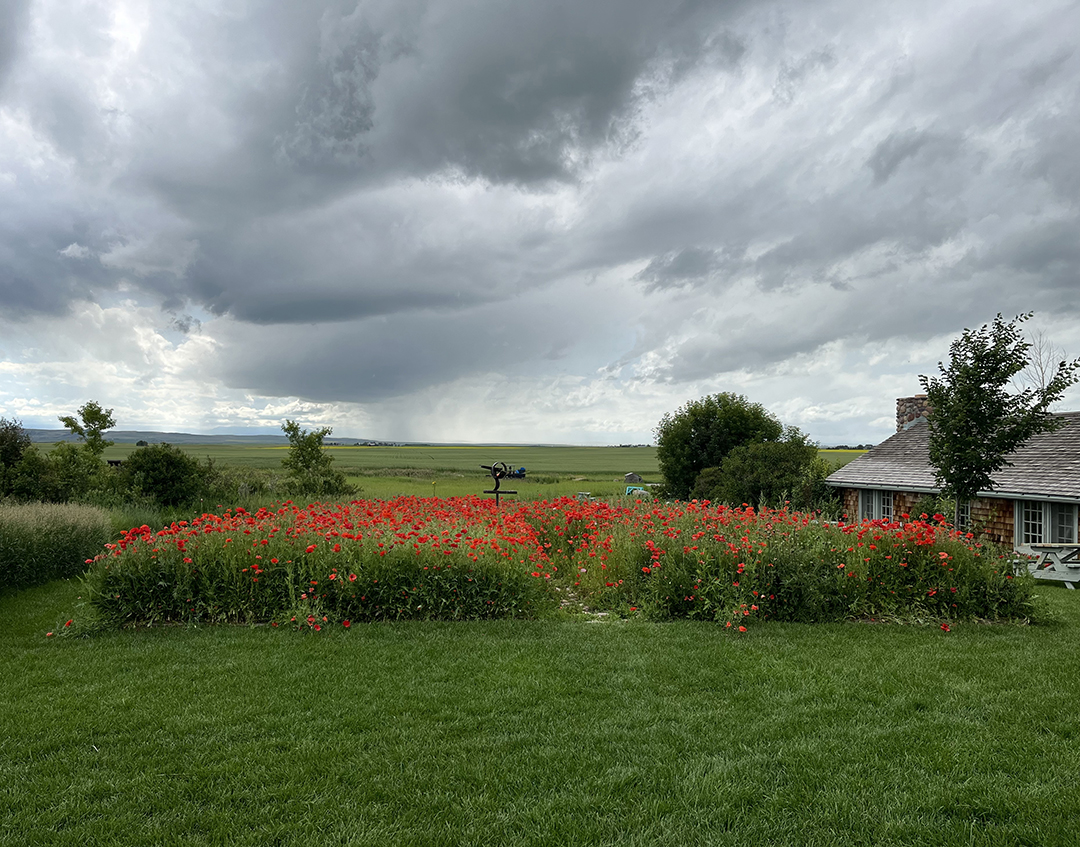
As Coutts watched his farm turn back into non-native grass lands, he soon realized he needed a course correction. “Unfortunately, I didn’t know enough of meadows or of native seed,” he writes wishfully in his well-kept gardening notes in 1996. His gardens are quite unique because they are entirely surrounded by crop land, not urban spread. A recent summer visitor would have noticed gorgeous, seemingly endless, yellow fields of Canola stretching out around the manicured gardens. A massive, square garden bed in front of the restored family home is filled with red hot Poppies (Papaver Rhoeas) against the silhouette of the Rocky Mountain Foothills in the distance.
Ready to walk his talk, the next year in 1997 Coutts files a $6,482 (almost $12,000 today) invoice for native grass seeds with his gardening journals. In a letter to a seed supplier, he writes, “I have been experimenting for 15 years with native grasses on small plots near Nanton. I did not realize how difficult it is to germinate seeds and reconstruct meadows. […] Recreating natural habitats is a difficult proposition.”
Matthews, the gardener at Coutts, has continued to maintain Coutts grass gardens for almost 15 years. “They are demonstration plots to show the public what native grasses can look like,” says Matthews. She says she spent all of her first summer at the Coutts gardens “just pulling Dandelions from the grass plots.” She also identified 32 species of grasses on the grounds, including invasives. The demonstration plots are providing insight into what grasses are good candidates for seeding larger meadows, she says.
The Coutts Centre is open to visitors for most of the summer. The demonstration plots provide opportunities to see mature grasses as well as new seedlings. Native grasses can add beautiful movement to flower gardens in the summer and interest to winter landscapes. Many varieties are easy to contain; there’s no reason to worry about grasses overtaking the entire garden, according to seed and plant suppliers. Native grass seeds can now be bought online. ALCLA Native Plants in Carstairs, Alta., says it sources seeds regionally to develop and preserve plant genetic diversity. Prairie Moon Nurseries, Winona, Minnesota, also offers a wide selection of native grass seeds.
In 1988, the very same year Jim Coutts set out to restore his family’s homestead, a group of national, provincial and non-profit stakeholders released the first Prairie Conservation Action Plan. That first plan intended to “conserve and manage native prairie species, communities and habitats.” Based in Lethbridge, Alta., The Prairie Conservation Forum, now grown to include Indigenous groups and many non-profits, just released its plans for 2026-2030. Its website contains many resources for gardeners interested in learning more about Prairie restoration, conservation and management
The Coutts Centre grounds can be viewed from May to October, but it’s best to check the website for opening hours or to call ahead if you plan to come with a group. The gardens are located East on Highway 533 from northbound QE2 in Nanton on Range Road 280.
Copyright 2026 – N. Heule. Article scheduled for publication in the annual The Prairie Garden magazine, 2027. I wrote this story after completing an artist residency at the Coutts Centre in summer 2025; a big thank-you goes to the wonderful staff at this very special place!

