“The extent to which we take everyday objects for granted is the precise extent to which they govern and inform our lives.” – Canadian philosopher Margaret Visser, 1986
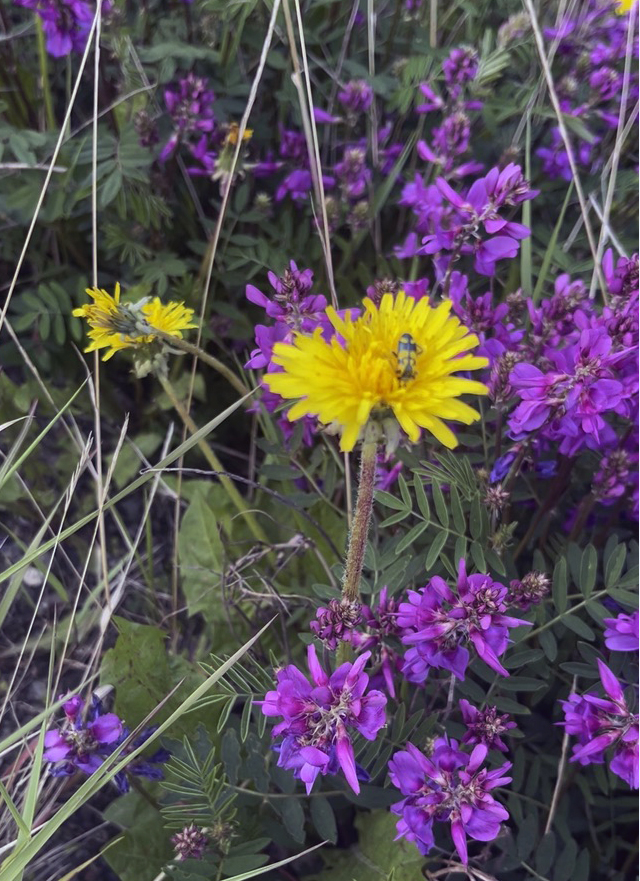
In my new collections project, I explore how the Common Dandelion (Taraxacum officinale) – an introduced species and non-human Settler from Euro-Asia – is both a proxy and a marker of human settlers’ dispersal in the land now known as Canada.
I’m working with a European woodcut dated 1597. (I love working with the early plant images that appear in herbals, the first printed books in Europe.) Dandelions are fun. Thus, art works I’m making will be colourful, relatable and joyful. Other materials I’m using include municipal maps, Google maps, herbarium samples (i.e. dried Dandelions preserved by scientists), iNaturalist, field notes and photos. I may use Dandelion flowers, leaves and roots to make sustainable ink. Most of the art work produced will use printmaking techniques.
My project intends to build a national, visual language of this settler plant. I’ve already worked in the far North and on the Prairies. Next, I plan to work in locations on the West and East Coasts, and at Point Pelee which is mainland Canada’s most southerly point. I am exploring how this seemingly insignificant flower may tell us something, perhaps quite a lot, about being settlers in Canada, about habitat destruction and capitalist land ownership.
Our cultural relationship to Dandelions is complex: they are sold as veggies in supermarkets. Yet Canadians spread lawn chemicals to kill them. Botanist categorize Dandelions as aliens, non-natives, noxious weeds, invasive or naturalized. There are also many folk names for Dandelions indicating their cultural significance. I use the term “settler” plant.
In contemporary culture, the Dandelion is often seen as a symbol of resilience and strength. Recent examples are the Canada Reads 2025 book titled Dandelion (Liew, 2022) and the international eco-campaign Project Dandelion (https://www.projectdandelion.com/). In the novel Wild Dark Shore, (McConaghy, 2025) a character identifies Dandelions “as the greatest traveler among them [plants].” Indeed, voyageurs, surveyors and early pioneers who travelled in Canada are romanticized, praised for their courage, strength, and resilience. But, unlike native flora and fauna, Dandelions and human settlers alike mostly find a home in disturbed soil, built environments, and along well-travelled paths.
I’ll provide updates on the project on this website and on Instagram @nandyheule.
 Nandy Heule