Dandelions Project

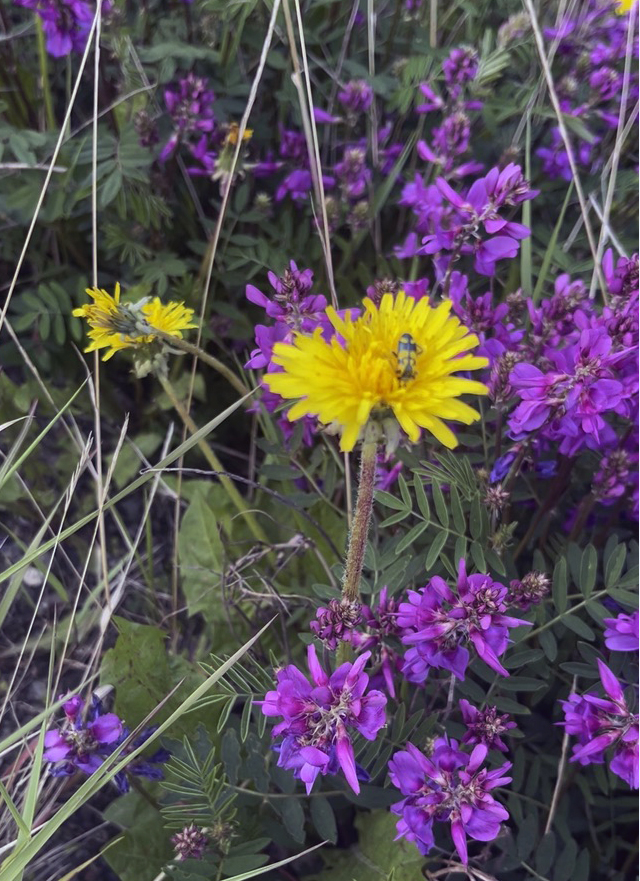
A bee rests on a Dandelion surrounded by Lupins, a native species, in the Yukon, 2025. That’s a bit ironic. Find out why.

In my new collections project, I explore how the Common Dandelion (Taraxacum officinale) – an introduced species and non-human settler from Euro-Asia – is both a proxy and a marker of human settler dispersal in the land now known as Canada.

Even a very small child will recognize a Dandelion and joyfully blow its puffball into the air. The popular nature platform iNaturalist shows 8,700 participants list over 21,000 observations of the plant across Canada. Yet does this plant — both maligned and cultivated — actually belong here? And may this settler plant present itself as a symbol of human settlers’ complex and layered relationship to the land itself?

I’m working with a European woodcut dated 1597. (I have been working with the early plant images that appear in herbals, among the very first printed books in Europe.) Other materials I’m using include municipal maps, Google maps, herbarium samples (i.e. dried Dandelions preserved by scientists) and data, iNaturalist data, field notes and photos. I may use Dandelion flowers, leaves and roots to make sustainable ink. Most of the art work produced will be works on paper using printmaking techniques.

My project intends to build a national, visual language of this settler plant. I’ve already worked in the far North and on the Prairies. Next, I plan to work in locations on the West and East coasts, and in southern Canada at Point Pelee, ON. I am exploring how this seemingly insignificant flower may tell us something, perhaps quite a lot, about being settlers in Canada, about habitat destruction, cultural assumptions and the impact of capitalist values on land ownership..

Our cultural relationship to Dandelions is complex: they are sold as veggies in supermarkets; yet Canadians spread lawn chemicals to kill them. Botanist categorize Dandelions as aliens, non-natives, noxious weeds, invasive or naturalized. There are also many folk names for Dandelions indicating their cultural significance. I use the term “settler” plant.

In contemporary culture, the Dandelion is often seen as a symbol of resilience and strength. Recent examples are the Canada Reads 2025 book titled Dandelion (Liew, 2022) and the international eco-campaign Project Dandelion https://www.projectdandelion.com. In the novel Wild Dark Shore, (McConaghy, 2025) a character identifies Dandelions “as the greatest traveler among them [plants].” Indeed, voyageurs, surveyors and early pioneers who travelled in Canada are romanticized, praised for their courage, strength, and resilience. But, unlike native flora and fauna, Dandelions and human settlers alike mostly find a home in disturbed soil, built environments, and along well-travelled paths.

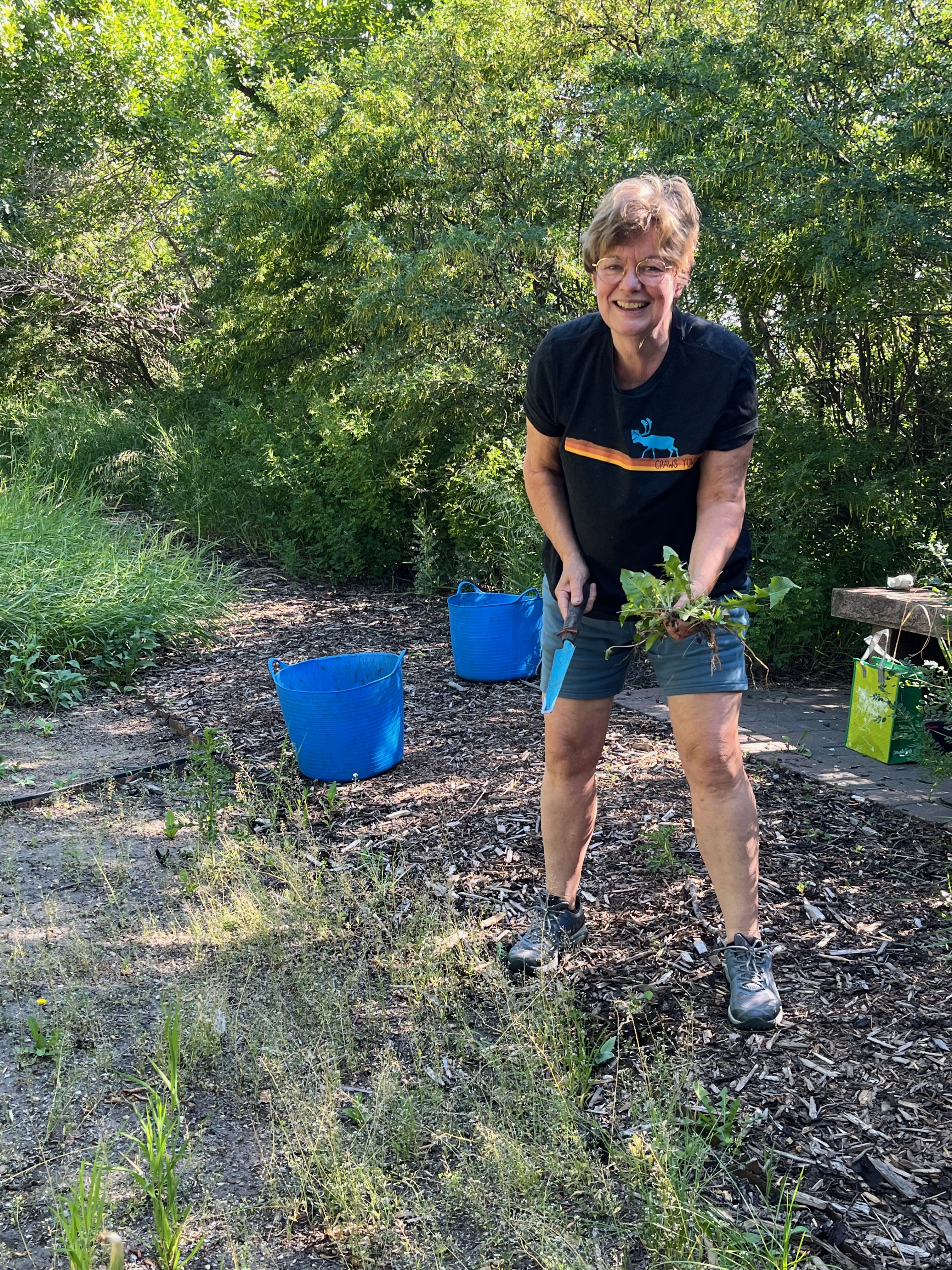
Pulling Dandelions from the native grass plots during artist’s residency at the Coutts Centre for Western Canadian Heritage near Nanton, AB

I plan to provide updates on this project here and on Instagram @nandyheule.

The Dandelion’s pallid Tube/Astonishes the Grass – And Winter instantly becomes/An Infinite Alas – The Tube uplifts a signal Bud/And then a shouting Flower – The proclamation of the Suns/That sepulture is o’er. – Emily Dickinson, American poet, 1881
Hey, Did You Drop Something?

Skip to my art installation

(Artist statement)

Auguste Rodin initially imagined his sculpture of Eve (1881) would be part of  his much larger work  Gates of Hell. However, the artist decided to exhibited Eve as an independent sculpture to high acclaim in Paris in 1881.

Why Rodin broke with long-standing convention, dating back centuries, to depict Eve without the apple and without Adam is unclear to me. (Adam and Eve are sometimes depicted together, but without an apple, when fleeing paradise which happens after the famous apple scene.)

My own reading of the sculpture tells me that Eve’s body posture expresses such agonizing regret and guilt, no apple is needed to remind the viewer of her role in throwing the world into more or less permanent disarray. In short, the woman has dropped “the forbidden fruit” because, to be blunt, there’s no doubt in Rodin’s own mind or the minds of much of patriarchal society, that she’s guilty as hell.

My installation Hey, did you drop something intends to question in a humorous way the male patriarchal explanation for the existence of evil: “’Why do bad things happen to good people?’ Obviously because a woman ate the forbidden fruit!”’ Specifically, I intend to trivialize the agonizing Eve and all she represents by asking her to pick up the apple and take a healthy, happy bite out of it.

Many thanks to Toronto sculpture Kip Jones and the technicians at OCADU for helping me produce the bronze apple.

Footnote: I’ve had opportunity to see Eve at the Frederick Meyer’s Sculpture Gardens in Grand Rapids, MI, on several occasions when visiting family. Every time I see it, I feel deeply moved by this sculpture. I’m not questioning the work itself, but rather the unfortunate myth it represents in such a powerful way.

 Source: musee-rodin.fr/en/collections/sculptures/eve.


Why you should care about stickers on your fruit

(Backgrounder: PLU code series)

Stickers on fruits and vegetables are officially known as PLU codes or price look-up codes.

Initially, in the 1990s, they contained bar codes only to facilitate inventory control. Soon, logos and website URLs were added. Now they are rather ingenious, tiny billboards.

In fact, a PLU sticker turns a banana into a brand. It doesn’t stop there. For example, put a few lettuce heads into a plastic bag, and, surprise, they turn into a “value-added vegetable product.” The “value-added” piece translates into more profit for food distributors, presumably because putting lettuce heads into a plastic bag with a PLU code on it makes our lives more convenient.

The 1400 PLU codes in circulation around the world today symbolize the globalization and the commercialization of basic food commodities.

I’ve been exploring this theme in the PLU Codes Project. This multi-year project includes a series of multi-media visual art pieces — all of them intended to make you smile, and, maybe, make you pause for a moment. I welcome your comments.

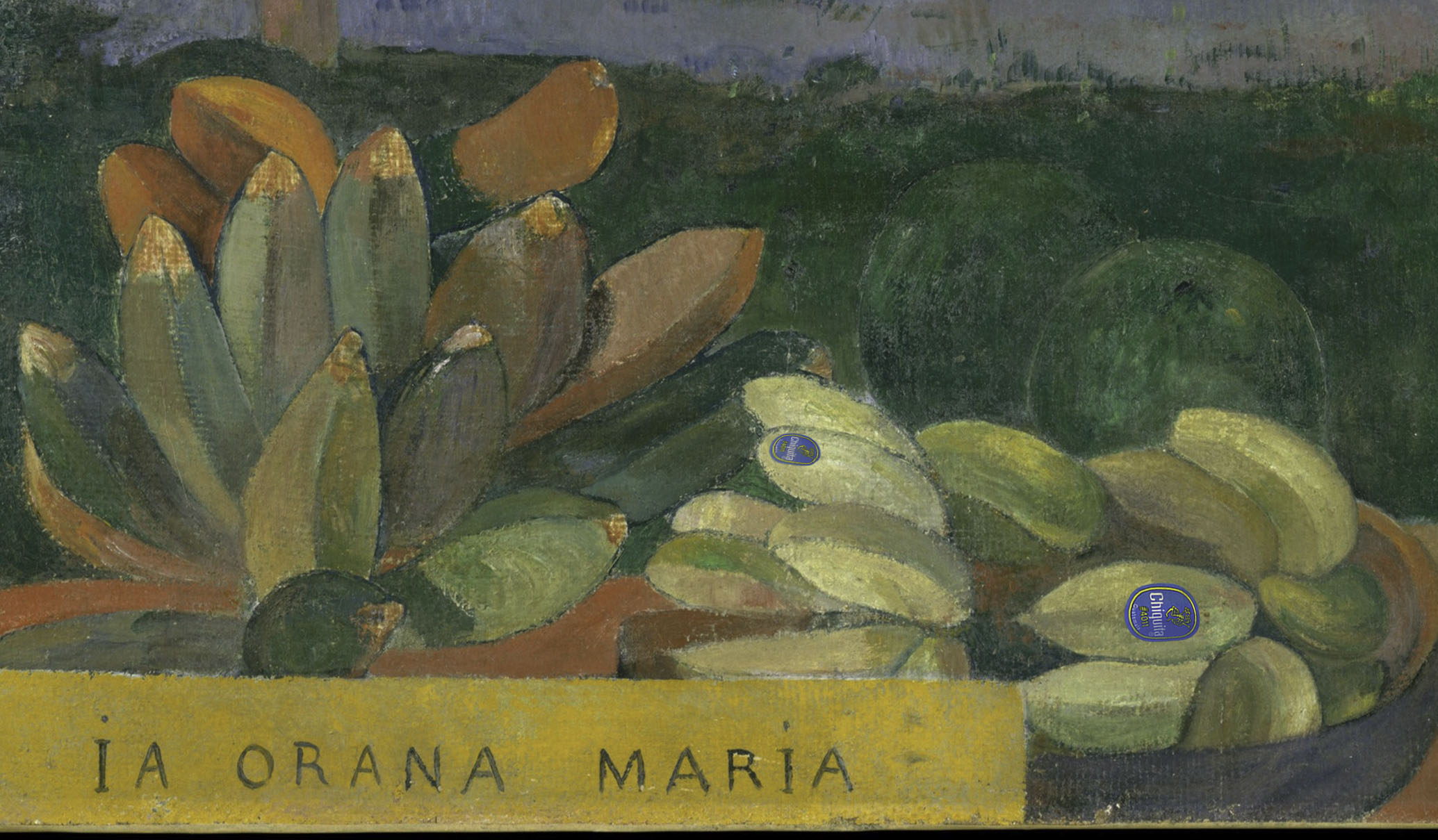
Photo credit: Detail of la Orana Maria, 1891, modified with PLU code, trademark TM Chiquita. Original image: Paul Gauguin (1848–1903). At the MET in NY, NY. Oil on canvas 113.7 cm x 87.6 cm. Bequest of Sam A. Lewisohn, 1951.  Concept copyright 2017 © by Nandy Heule